We have compiled a list of manufacturers, distributors, product information, reference prices, and rankings for Photo Receiver.
ipros is IPROS GMS IPROS One of the largest technical database sites in Japan that collects information on.

Photo Receiver - List of Manufacturers, Suppliers, Companies and Products | IPROS GMS

Photo Receiver Product List

1~11 item / All 11 items

Displayed results

Variable Gain Photo Receiver (OE-200 Series)

A gain-variable photoreceiver optimal for high-speed measurement of various weak lights.

- The conversion efficiency can be set from a range of 10^3 to 10^11 V/W, and AC/DC coupling can also be changed. - It can be controlled both manually and via PC with optical isolation remote. - With a low-noise multi-stage amplifier design and a switchable 10Hz low-pass filter, it can measure optical power down to a minimum range of 100 fW with high accuracy, eliminating the need for signal averaging. - High stability, reduced drift, and calibration based on NIST standards ensure accurate measurements with high stability even at maximum gain settings. - It is ideal for high-speed photodetectors and lock-in amplifier systems in industrial process management and quality inspection systems. - The maximum bandwidth is 500 kHz, making it suitable for time-resolved measurements down to sub-microseconds.

  • Other electronic parts
  • Photo Receiver

Added to bookmarks

Bookmarks list

Bookmark has been removed

Bookmarks list

You can't add any more bookmarks

By registering as a member, you can increase the number of bookmarks you can save and organize them with labels.

Free membership registration

2GHz Photo Receiver (HSA-X-S Series)

A high-performance 2GHz photoreceiver that combines cutting-edge photodiode technology with GHz amplifiers from Femto.

- The diode type is made of Si/InGaAs, with wavelength ranges of 320–1000nm/850–1700nm respectively. - The Si model HSA-X-S-1G4-SI has a ball range placed on the front of the detector chip, with an active area diameter of 0.8mm. - The transimpedance is 5×10^3 V/A. - The minimum NEP is only 14pW/vHz, making it measurable even at μW range optical power levels.

  • Other optical parts
  • Other measurement, recording and measuring instruments
  • Photo Receiver

Added to bookmarks

Bookmarks list

Bookmark has been removed

Bookmarks list

You can't add any more bookmarks

By registering as a member, you can increase the number of bookmarks you can save and organize them with labels.

Free membership registration

1.5µm wavelength CW linewidth 3kHz, 15W fiber laser

This is a single-frequency continuous wave laser using a self-developed fiber DFB module with a wavelength of 1550 nm, a linewidth of 3 kHz, and an average power of 15 W.

Manufacturer: Connet Laser Technology (China) Narrow linewidth, high power, high-quality beam. Connet's "CoSF-D" is a low-noise single-frequency fiber laser using DFB technology. It achieves high output with single frequency, linear polarization, and narrow linewidth through unique technology. The unit introduced here has a wavelength of 1550 nm, an ultra-narrow linewidth of 3 kHz, and an average power of 15 W. The CoSF-D also boasts excellent performance in terms of phase noise and RIN. Its unique packaging technology enables a low-noise DFB single-frequency fiber laser with outstanding wavelength stability. It is offered at a reasonable price. ------------------------------------------------------ Features ------------------------------------------------------ ● Ultra-narrow linewidth < 5 kHz ● Wavelength selectable from 1530 - 1572 nm ● Maximum average power of 50 W ● Ultra-low phase noise and frequency noise ● RIN @10MHz: -155 dBc/Hz (typ.)

  • 3.jpg
  • 4.jpg
  • Laser Components
  • Amplifier
  • others
  • Photo Receiver

Added to bookmarks

Bookmarks list

Bookmark has been removed

Bookmarks list

You can't add any more bookmarks

By registering as a member, you can increase the number of bookmarks you can save and organize them with labels.

Free membership registration

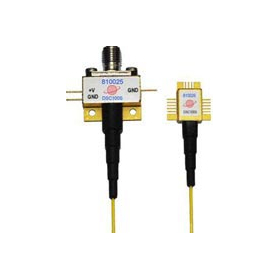
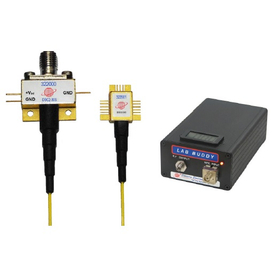
High-speed photodiode and photoreceiver compatible with a wavelength of 2 microns.

It is a photodiode and photoreceiver that supports wavelengths from 1200 to 2200 nm and a bandwidth of up to 22 GHz.

Manufacturer: Discovery Semiconductors (USA) Discovery has been successful for many years in the commercialization of high-speed, 2.2µm cutoff, and cooling-free InGaAs SWIR photoreceivers. In February 2002, they released a PIN+TIA photoreceiver for the LIDAR community, and in 2012, they expanded their product lineup to include high-speed photodiodes up to 20GHz and linear balanced photoreceivers up to 18GHz. These products are creating new applications in various fields such as biomedical and environmental sensors. ------------------------------------------------------ Product Lineup ------------------------------------------------------ ● 2.2µm InGaAs photodiode - high power support up to 5GHz ● 2.2µm InGaAs photodiode - high-speed band up to 20GHz ● 2.2µm photoreceiver

  • 2um-2.jpg
  • 2um-3.jpg
  • 2um-4.jpg
  • Laser Components
  • Amplifier
  • others
  • Photo Receiver

Added to bookmarks

Bookmarks list

Bookmark has been removed

Bookmarks list

You can't add any more bookmarks

By registering as a member, you can increase the number of bookmarks you can save and organize them with labels.

Free membership registration

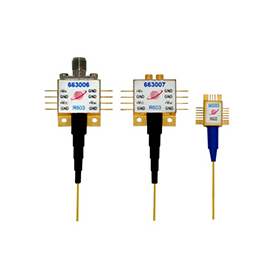
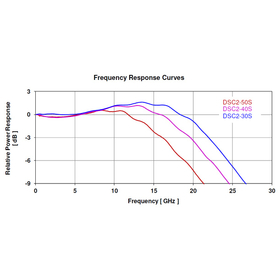
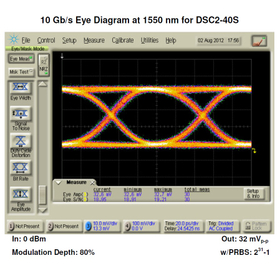
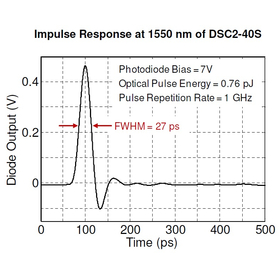
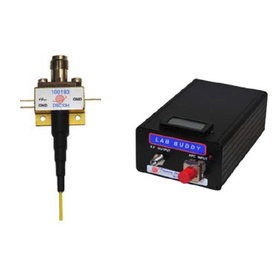
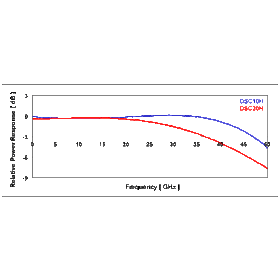
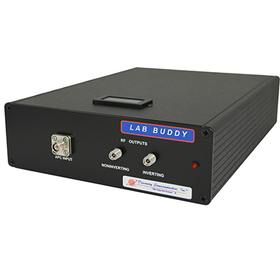
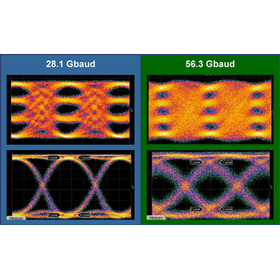
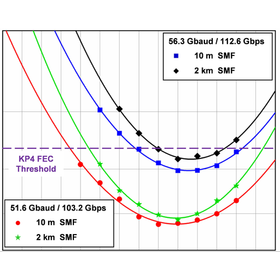
Up to 50GHz, high-speed photodiode, photoreceiver

It is a photodiode and photoreceiver that supports wavelengths from 800 to 1650 nm and bandwidths up to 50 GHz.

Manufacturer: Discovery Semiconductors (USA) In 1997, at the Optical Fiber Communication Conference (OFC) held in Dallas, Texas, we announced the first commercially available 40 Gb dual-depletion InGaAs/InP p-i-n photodiode. Since then, we have developed cutting-edge products such as balanced photodiodes for 40 Gb and ultra-fast photodiodes with speeds up to 60 GHz. ------------------------------------------------------ Product Lineup ------------------------------------------------------ ● InGaAs PIN Photodiode: ~60 GHz ● (PIN or APD) + TIA Photoreceiver: ~56 Gbaud ● Balanced PIN Photodiode: 40 Gb/s ● Balanced PIN + (TIA or LNA) Photoreceiver: 40 G DPSK・DQPSK

  • 50g2.gif
  • 50g3.png
  • 50g4.png
  • 50g5.png
  • Laser Components
  • Amplifier
  • others
  • Photo Receiver

Added to bookmarks

Bookmarks list

Bookmark has been removed

Bookmarks list

You can't add any more bookmarks

By registering as a member, you can increase the number of bookmarks you can save and organize them with labels.

Free membership registration

Femto-watt photoreceiver (FWPR series)

FEMTO Messtechnik GmbH is a leading manufacturer of low-noise amplifier modules.

■FWPR-20 - A photoreceiver combined with a low-noise Si/InGaAs photodiode and a very high-gain (maximum: 10^12 V/A) low-noise transimpedance amplifier. - Achieves a very low NEP value (minimum: 0.7 fW/√Hz) and high sensitivity in the femtowatt range. - For detection with the photoreceiver alone, it can detect optical power down to approximately 50 fW, and when combined with a Femto lock-in amplifier, it achieves high sensitivity in the sub-femtowatt range. - Due to its very high sensitivity, it can be used in many applications. - It can be used as an alternative to APD, PMT, and cooled Ge photodiodes without the need for expensive high-voltage power supplies or cooling devices.

  • Optical Experimental Parts
  • Other electronic parts
  • Photo Receiver

Added to bookmarks

Bookmarks list

Bookmark has been removed

Bookmarks list

You can't add any more bookmarks

By registering as a member, you can increase the number of bookmarks you can save and organize them with labels.

Free membership registration

400MHz Photo Receiver (HCA-S-400 Series)

400MHz photoreceiver combining high-speed photodiode technology and high-speed current amplifier from Femto.

- There are two types of diodes: Si and InGaAs, with wavelength ranges of 320–1000nm and 900–1700nm, respectively. - The transimpedance is 5×10^3 V/A, and the maximum conversion gain for the InGaAs model at 1550nm is 5×10^3 V/W. - The sophisticated DC-coupled multi-stage amplifier design allows for measurements with a bandwidth of DC–400MHz, corresponding to a minimum rise time of 1ns. - Due to low noise, measurements can be taken without averaging even with light levels of a few μW. - The input can be free space or fiber coupled.

  • Other optical parts
  • Other measurement, recording and measuring instruments
  • Photo Receiver

Added to bookmarks

Bookmarks list

Bookmark has been removed

Bookmarks list

You can't add any more bookmarks

By registering as a member, you can increase the number of bookmarks you can save and organize them with labels.

Free membership registration

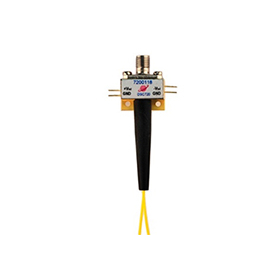
Space Environment Compatible High-Speed Photodiode Photoreceiver

It is a photodiode and photoreceiver capable of withstanding harsh space environments such as extreme temperature changes and ultra-high vacuum.

Manufacturer: Discovery Semiconductors (USA) Introducing Discovery's space-qualified model. This is a highly reliable model that has been proven to operate without performance degradation even in the harsh environment of outer space. ------------------------------------------------------ Product Lineup ------------------------------------------------------ ● InGaAs PIN Photodiode: Wavelength 800–1650 nm, up to 1 GHz ● InGaAs PIN Photodiode: Wavelength 800–2400 nm, up to 400 MHz ● InGaAs Balanced AGC Photoreceiver: up to 4 GHz

  • space2.jpg
  • space4.jpg
  • space5.jpg
  • Laser Components
  • Amplifier
  • others
  • Photo Receiver

Added to bookmarks

Bookmarks list

Bookmark has been removed

Bookmarks list

You can't add any more bookmarks

By registering as a member, you can increase the number of bookmarks you can save and organize them with labels.

Free membership registration

400kHz photoreceiver (LCA-S-400 series)

A large-diameter 400kHz photoreceiver that combines cutting-edge photodiode technology with low-noise current amplifier technology.

■The photodiodes used are made of Si or InGaAs, with wavelength ranges of 400–1050nm and 900–1700nm, respectively. ■The transimpedance is 10^7 V/A, and the maximum conversion gain is 9.5×10^6 V/W at 1550nm for the InGaAs model. ■The minimum NEP is approximately 75 fW/√Hz, allowing for the measurement of light signals in the nanowatt range without unnecessary averaging.

  • Other optical parts
  • Other measurement, recording and measuring instruments
  • Photo Receiver

Added to bookmarks

Bookmarks list

Bookmark has been removed

Bookmarks list

You can't add any more bookmarks

By registering as a member, you can increase the number of bookmarks you can save and organize them with labels.

Free membership registration

Variable Gain Photoreceiver (OE-300 Series)

The OE-300 photo receiver consists of a premium quality photodiode followed by a high-end variable gain transimpedance amplifier.

- The low noise performance (NEP) is excellent, particularly setting a benchmark for wideband photoreceivers with gain settings in the high and mid-frequency ranges. - The relatively large size of the detector facilitates optical alignment, and when using the Si model with the optionally available fiber optic adapter PRA-FC/SMA, it also guarantees very high coupling efficiency. - The switchable gain of 102 to 108 V/A (in decimal units) allows for accurate and reliable measurements over a very wide dynamic range, from nanowatts to a maximum of 10 mW of optical power. - With many additional features such as a switchable low-pass filter, offset adjustment, switchable AC/DC coupling, and manual and opto-isolated remote control functions via PC, the OE-300 is the most versatile wideband photoreceiver in its class.

  • Other electronic parts
  • Photo Receiver

Added to bookmarks

Bookmarks list

Bookmark has been removed

Bookmarks list

You can't add any more bookmarks

By registering as a member, you can increase the number of bookmarks you can save and organize them with labels.

Free membership registration

200MHz Photo Receiver (HCA-S-200 Series)

200MHz photoreceiver combining high-speed photodiode technology and high-speed current amplifier from Femto.

- There are two types of diodes: Si-based and InGaAs-based, with wavelength ranges of 320–1000nm and 900–1700nm, respectively. - The transimpedance is 2×10^4 V/A, and the maximum conversion gain for the InGaAs model at 1550nm is 2×10^4 V/W. - Thanks to a sophisticated DC-coupled multi-stage amplifier design, measurements with a bandwidth of DC–200MHz corresponding to a minimum rise time of 1.8ns are possible. - The minimum NEP value is approximately 6pW/√Hz, allowing for the detection of optical power signals in the μW range without unnecessary averaging.

  • Other optical parts
  • Other measurement, recording and measuring instruments
  • Photo Receiver

Added to bookmarks

Bookmarks list

Bookmark has been removed

Bookmarks list

You can't add any more bookmarks

By registering as a member, you can increase the number of bookmarks you can save and organize them with labels.

Free membership registration